Light Lab
PlaygroundThe others with no size
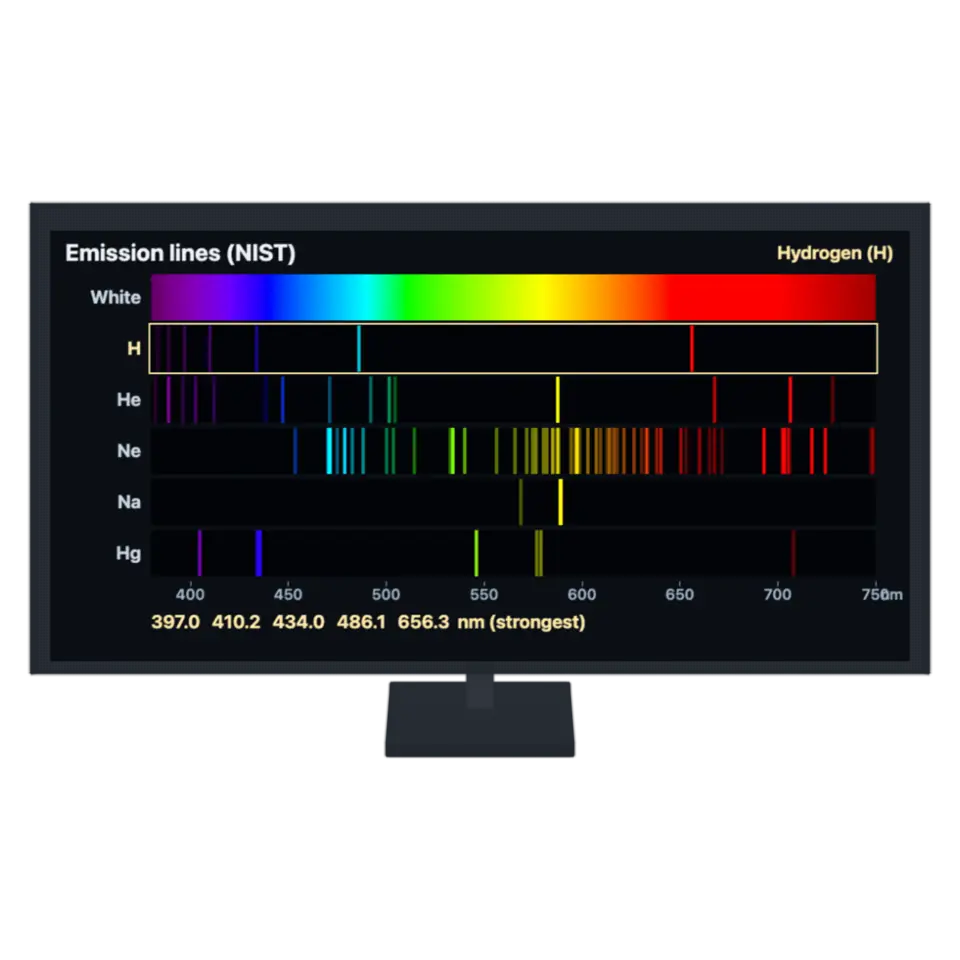
Every element glows in its own colors.
- Shelf
- Lab
- Kind
- Built from a recipe
- Your own
- Light lab
- Sound
- Yes
- Licenses
- Facts
How to play, in the Playground
Tap for the next element or lamp. The Splash tab picks a prism, a grating or your camera as a spectrometer.
Its controls
| Control | Kind | Range | Start |
|---|---|---|---|
| Next element or lamp | Tap | ||
| Next | Button | ||
| Show | List | 4 choices | Line spectra to compare |
| Elements | List | 5 choices | Lamps: hydrogen, helium, neon, sodium, mercury |
| Prism glass | List | 2 choices | Dense flint glass (N-SF11) |
| Grating | List | 3 choices | A CD (1.6 µm tracks, 625 per mm) |
About it
Every element glows in its own colors. Its electrons jump up and fall back, each fall giving off light of one exact wavelength, so an element's light split by a prism is a few sharp lines, as unique as a fingerprint. These are the strong visible lines of sixteen elements measured by NIST, brightness from NIST's relative intensities.
The prism bends each color by Snell's law, from the glass maker's formula for its index: blue bends most. A grating (a CD, a DVD or a slide) sends each color off where d sin θ = m λ: red bends most, in several orders. Tap to change the lamp and every ray moves. Home spectrometer: hold an old CD or DVD near your camera under a fluorescent lamp, find the rainbow in it and tap “Use my camera”. It calibrates on mercury's 436 and 546 nm lines. Simplified: screens can't show pure spectral colors, and a real lamp's line strengths depend on its pressure and heat.
Details
- Splats
- Opens at 200,000 at Mid Detail, 105,328 at Low, and up to 570,000 at Max
- Your own files
- image/*
Is it right?
The Light lab shows the visible emission lines of sixteen elements as NIST lists them, traces white light and each lamp's lines through a glass prism (Snell's law with the glass maker's dispersion formula) and through a CD, DVD or grating slide (the grating equation), and reads a spectrum from a camera picture calibrated on mercury's lines. The wavelengths and angles are exact; the colors and brightnesses are approximations.
Correct
Each element's lines are at the wavelengths NIST lists (in air), with NIST's relative intensities.1234
tools/sll-nist.mjs reads each element's Handbook 'Strong Lines' table (air wavelengths, 380 to 750 nm, the neutral atom) into src/labs/nist-lines.js, digit for digit.
Correct
A prism bends blue more than red, by Snell's law and the glass's index.56
Each ray is refracted at both faces by Snell's law in vector form; the index comes from Schott's Sellmeier coefficients for N-SF11 and N-BK7. The beam meets the prism at the angle of minimum deviation for 550 nm.
Correct
A grating sends each color off at the angle where d sin θ = m λ; a CD's tracks are about 1.6 µm apart and a DVD's about 0.74 µm.789
Every ray of orders −2 to +2 at normal incidence; an order that would need sin θ > 1 is left out.
Close
The home spectrometer finds a fluorescent lamp's mercury lines and calibrates its scale on them.110
A band of the picture is averaged into a brightness per column; the bluest peak is taken as 435.8 nm and the greenest as 546.1 nm (both NIST), and a straight line through them maps columns to wavelengths.
- 1Handbook of Basic Atomic Spectroscopic Data, NIST Physical Measurement Laboratory
- 2Strong Lines of Hydrogen, NIST
- 3Strong Lines of Mercury, NIST
- 4Strong Lines of Sodium, NIST
- 5N-SF11 and N-BK7 (SCHOTT optical glass), RefractiveIndex.INFO
- 6Minimum deviation, Wikipedia
- 7Diffraction grating, Wikipedia
- 8Compact disc, Wikipedia
- 9Exploring Light and Color guide (DVD and CD as gratings), NISE Network
- 10Fluorescent lamp, Wikipedia
- Simplified
- Colors follow Dan Bruton's approximation of the visible spectrum (as in the colorwav package, https://ctan.org/tex-archive/macros/latex/contrib/colorwav); screens can't show pure spectral colors.
- Simplified
- Only the neutral atom's lines are shown (a lamp's ions add lines of their own), and lines weaker than 2% of an element's strongest are left off the bench.
- Simplified
- Line brightness is drawn on a square-root scale of NIST's relative intensities, which themselves depend on the light source NIST's references used; a real lamp's line strengths depend on its pressure and temperature.
- Simplified
- Lines are drawn sharp; real lines have widths, and the slit and optics blur them.
- Simplified
- The bench's grating is drawn as letting light through; a CD or DVD reflects it, with the same angles at normal incidence.
- Simplified
- The sample picture for the spectrometer is made by the page: mercury's lines and approximate phosphor bands, not a photograph.